Navigating the beautiful yet
complex city of Prague
How humans construct mental models of space when external systems are incomplete or overwhelming.
One-line thesis
Navigation is not route-finding. It is the continuous construction and correction of a mental model of space.
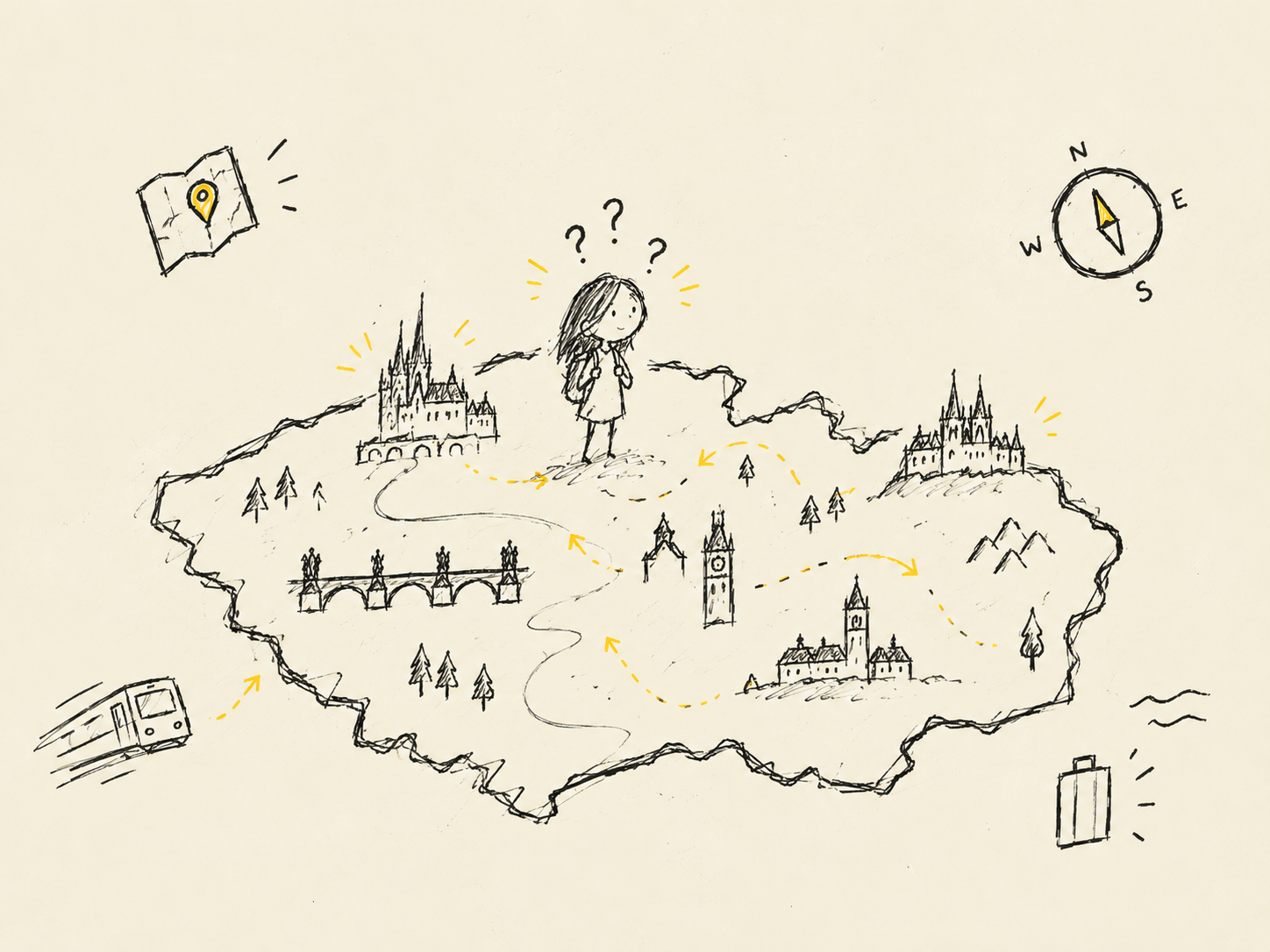
Orientation felt unstable, even with GPS.
While navigating Prague, a recurring pattern emerged. Even with maps and GPS, orientation often felt unstable. Not because the system failed, but because the mental model of the city never fully stabilized.
The city was
- ▪Visually rich
- ▪Structurally inconsistent
- ▪Cognitively dense
- ▪Non-linear in layout perception
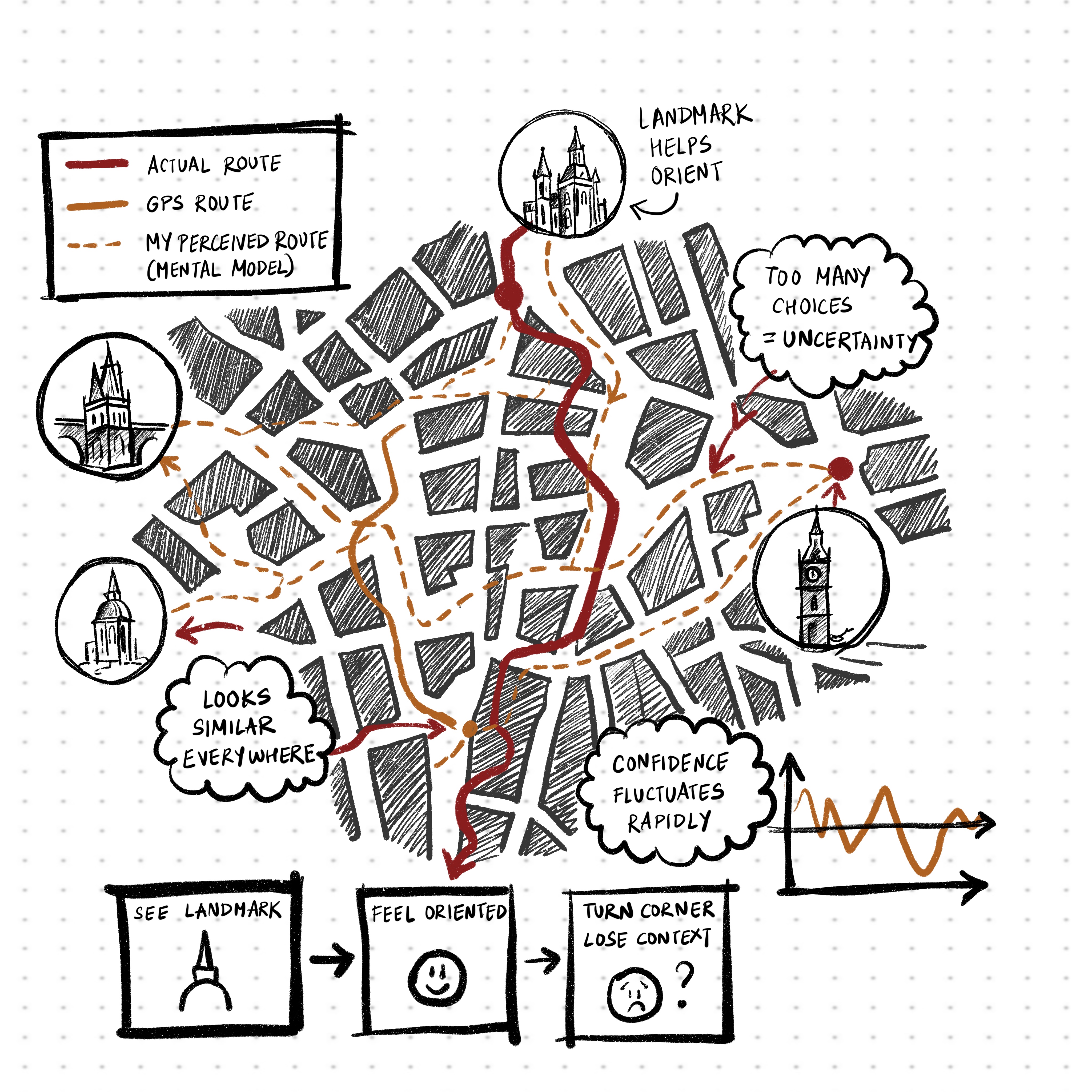
Not "how do we navigate". How do we build maps under uncertainty?
How do humans construct spatial understanding in environments that resist linear mapping? This reframed the problem from "How do we navigate efficiently?" to "How do we build mental maps under uncertainty?"
Reframe
How do humans build mental maps under uncertainty?
Four patterns, repeated across every visitor.
Landmark dependency increases over time
Users rely on memory anchors rather than full maps.
Route repetition replaces optimization
Familiar paths become preferred over shorter unknown routes.
Direction confidence fluctuates rapidly
Small errors create disproportionate uncertainty.
Map vs reality mismatch
Digital maps feel detached from lived spatial experience.
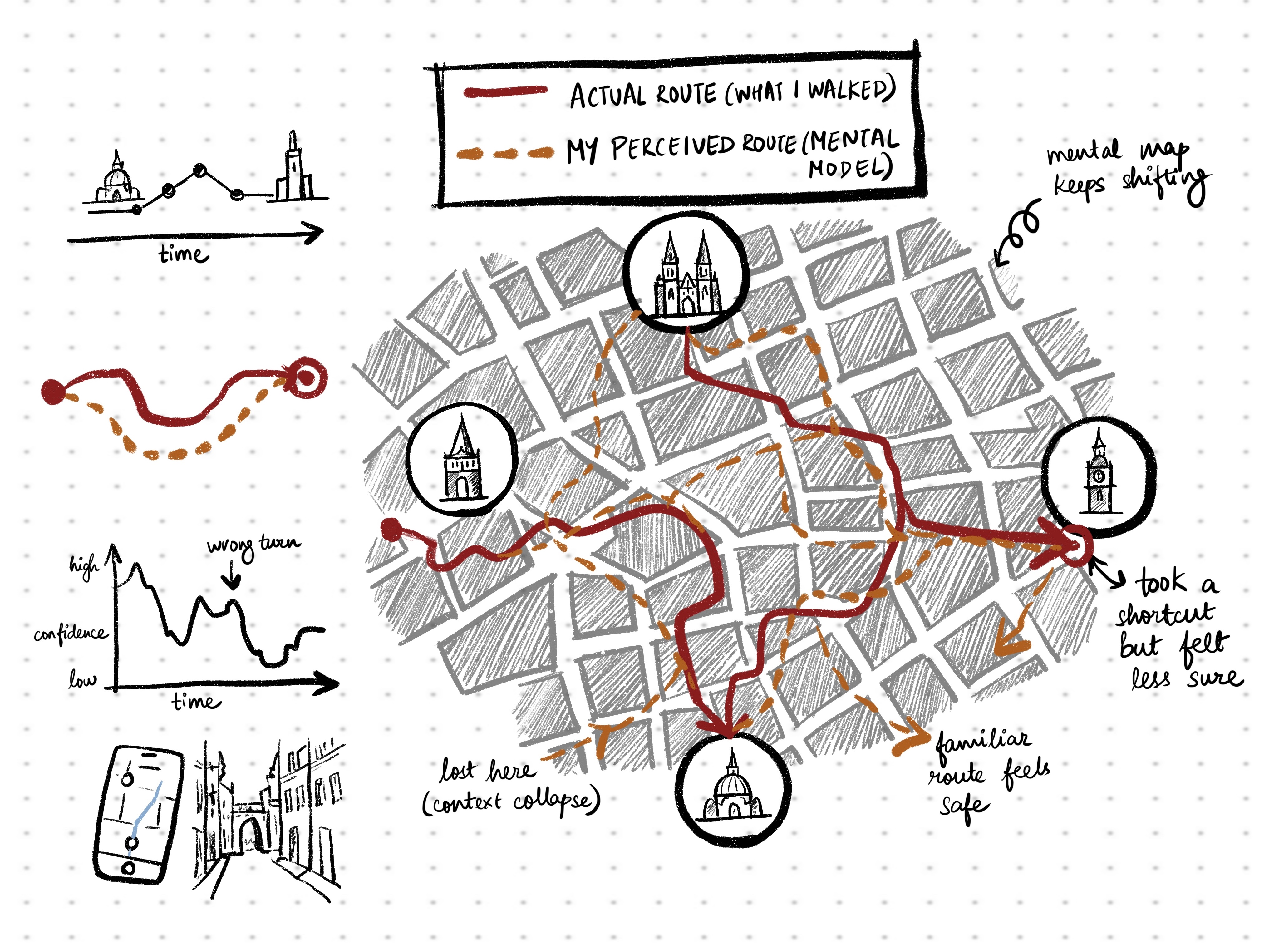
Navigation is about confidence in spatial belief, not accuracy.
Users do not need perfect directions. They need a stable enough mental model to move forward without hesitation. Accuracy without confidence produces a user who is technically on the right path and emotionally certain they are lost.
They need
- →A stable enough mental model to move forward without hesitation
Key insight
Navigation is not about accuracy. It is about confidence in spatial belief.
A personalized map, not a geographic one.
Humans build spatial understanding through four cumulative inputs. Over time, this forms a personalized cognitive map, not a geographic one.
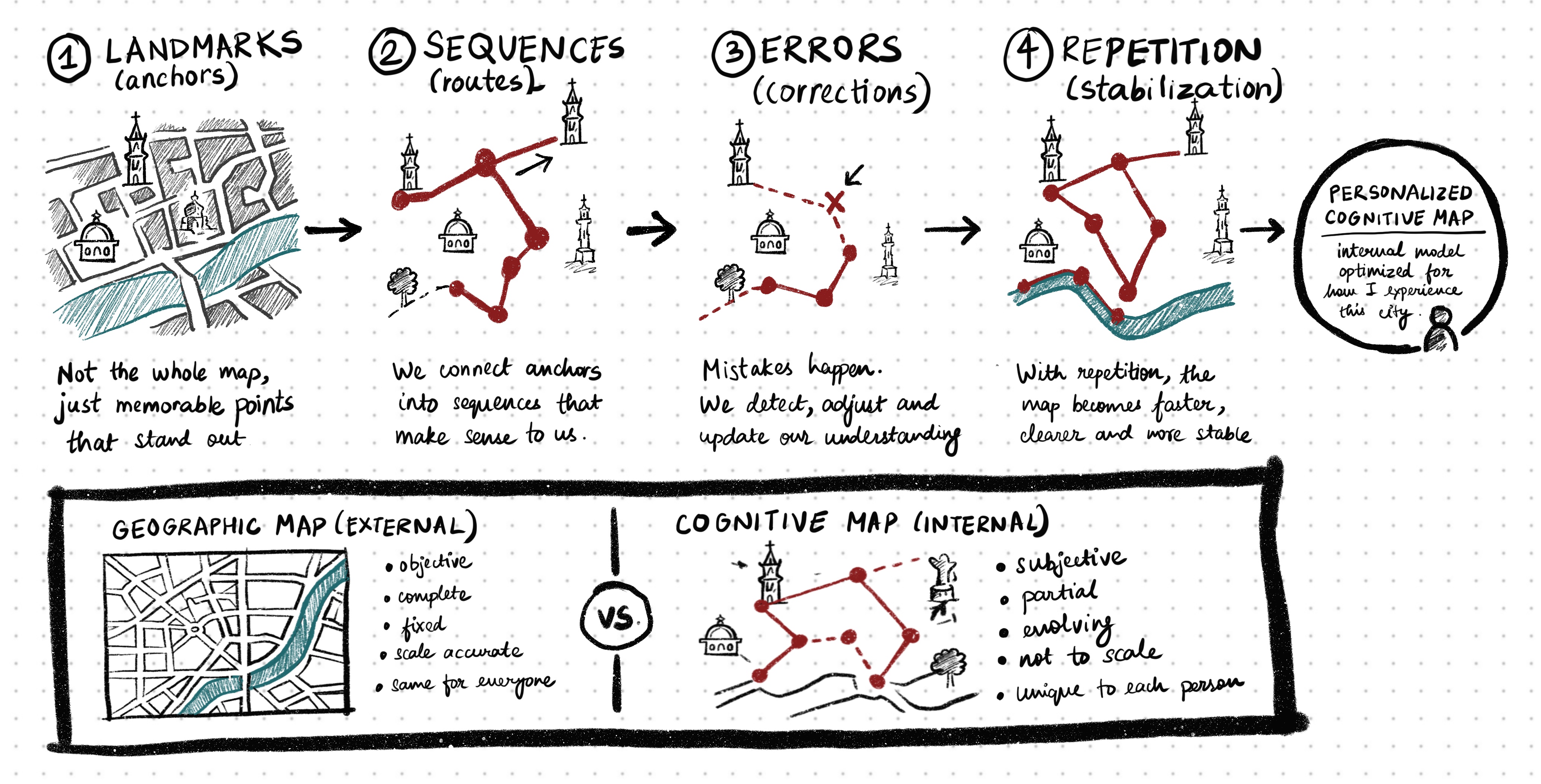
Maps are scaffolds for decision-making, not representations of space.
The purpose of navigation tools is not accuracy, completeness or detail. It is reducing uncertainty at decision points. A map that is perfectly accurate but overwhelms the user at every junction has failed its only real job.
The purpose is not
- ✕Accuracy
- ✕Completeness
- ✕Detail
Key insight
Maps are not representations of space. They are scaffolds for decision-making.
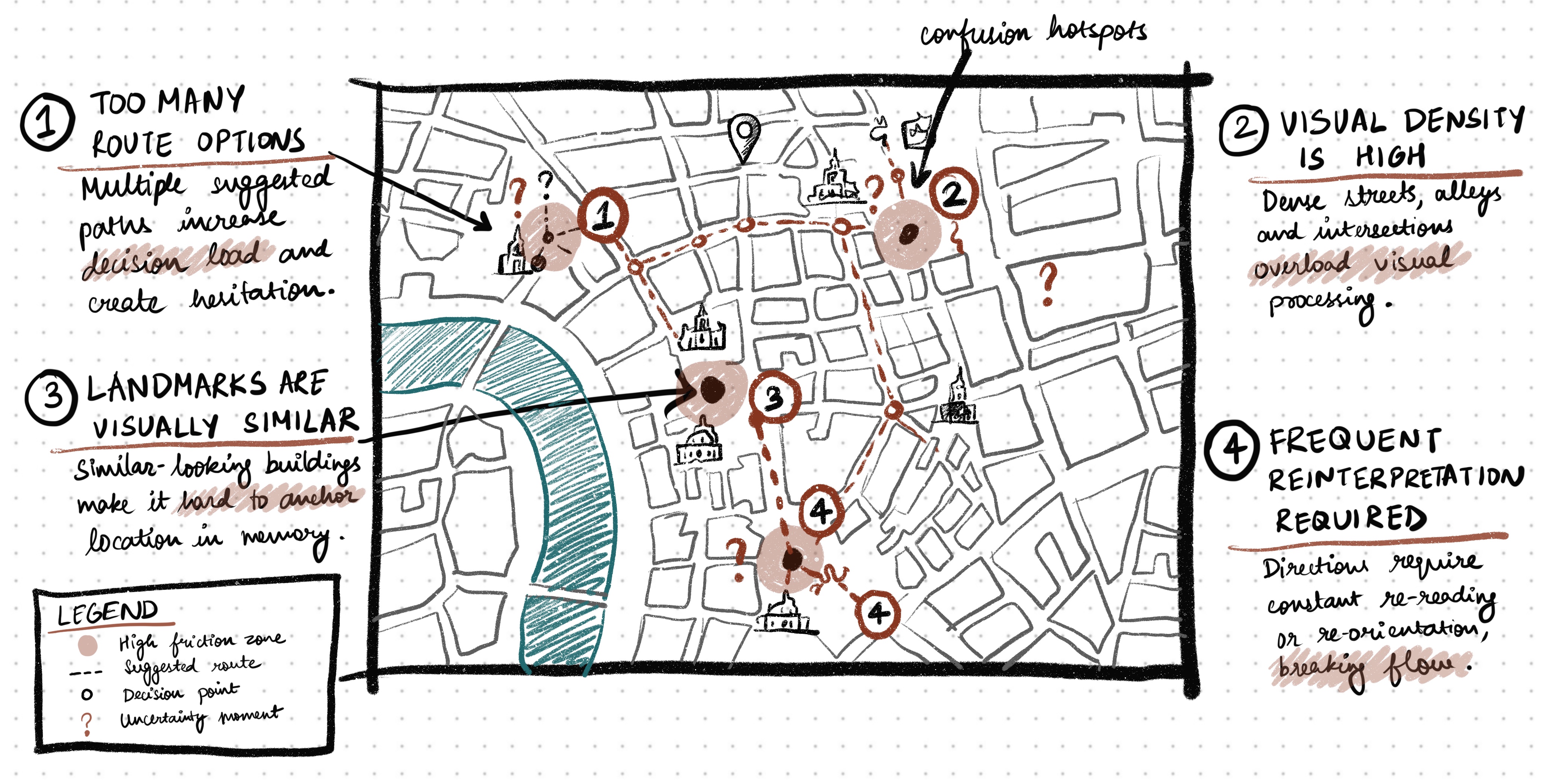
Where the system breaks the mental model.
Friction occurred when
- →Too many route options were presented at once
- →Visual density of streets was high and unstructured
- →Landmarks were visually similar and easily confused
- →Directions required frequent reinterpretation
Humans prefer stable mental maps over optimal routes.
Even when shorter routes exist, users choose familiar paths, avoid uncertainty zones, and prioritize predictability over efficiency. The optimal route is not the shortest one. It is the one the user trusts.
Key insight
Humans prefer stable mental maps over optimal routes.
Navigation systems are cognitive stabilization systems.
Navigation systems are not route engines. They are cognitive stabilization systems for spatial uncertainty. The measure of a good system is not the shortest path it computes, but the confidence it restores at every decision point.
Reduce cognitive reconstruction effort.
Good navigation systems minimize reinterpretation, reinforce landmarks, reduce decision branching, and stabilize directional confidence. The work of the system is to keep the mental model intact, not to redraw the world.
They should
- →Minimize reinterpretation
- →Reinforce landmarks
- →Reduce decision branching
- →Stabilize directional confidence
Familiarity beats optimization in spatial UX.
Even suboptimal routes become preferable when cognitive load is lower and confidence is higher. A route the user trusts will be used again. A route the user doubts will be abandoned regardless of how short it is.
Key insight
Familiarity is more valuable than optimization in spatial UX.
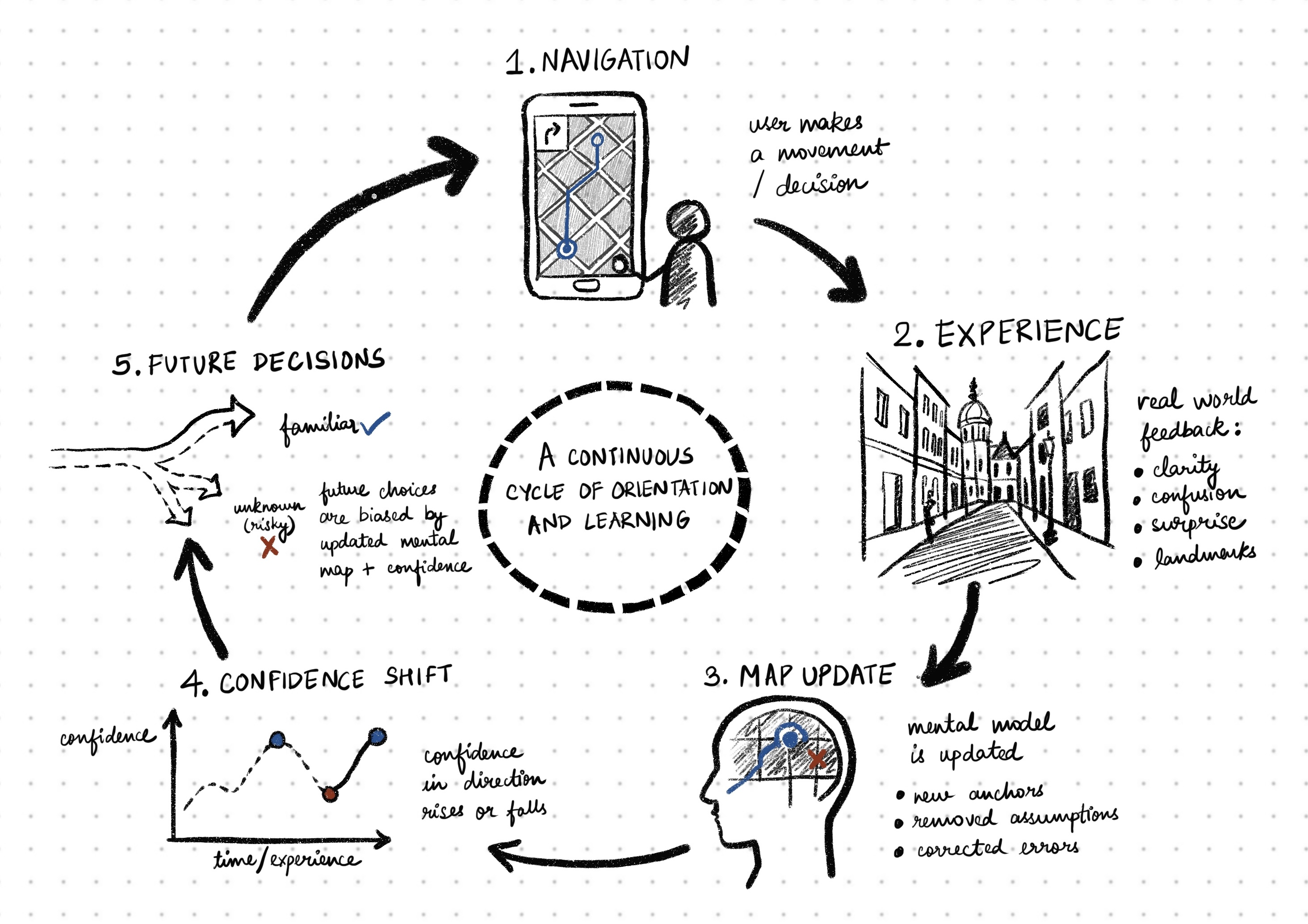
Spatial UX is a feedback loop, not a static instruction.
Each movement updates the mental map, reinforces or breaks confidence, and adjusts future decisions. A navigation system that does not close this loop is only half a system.
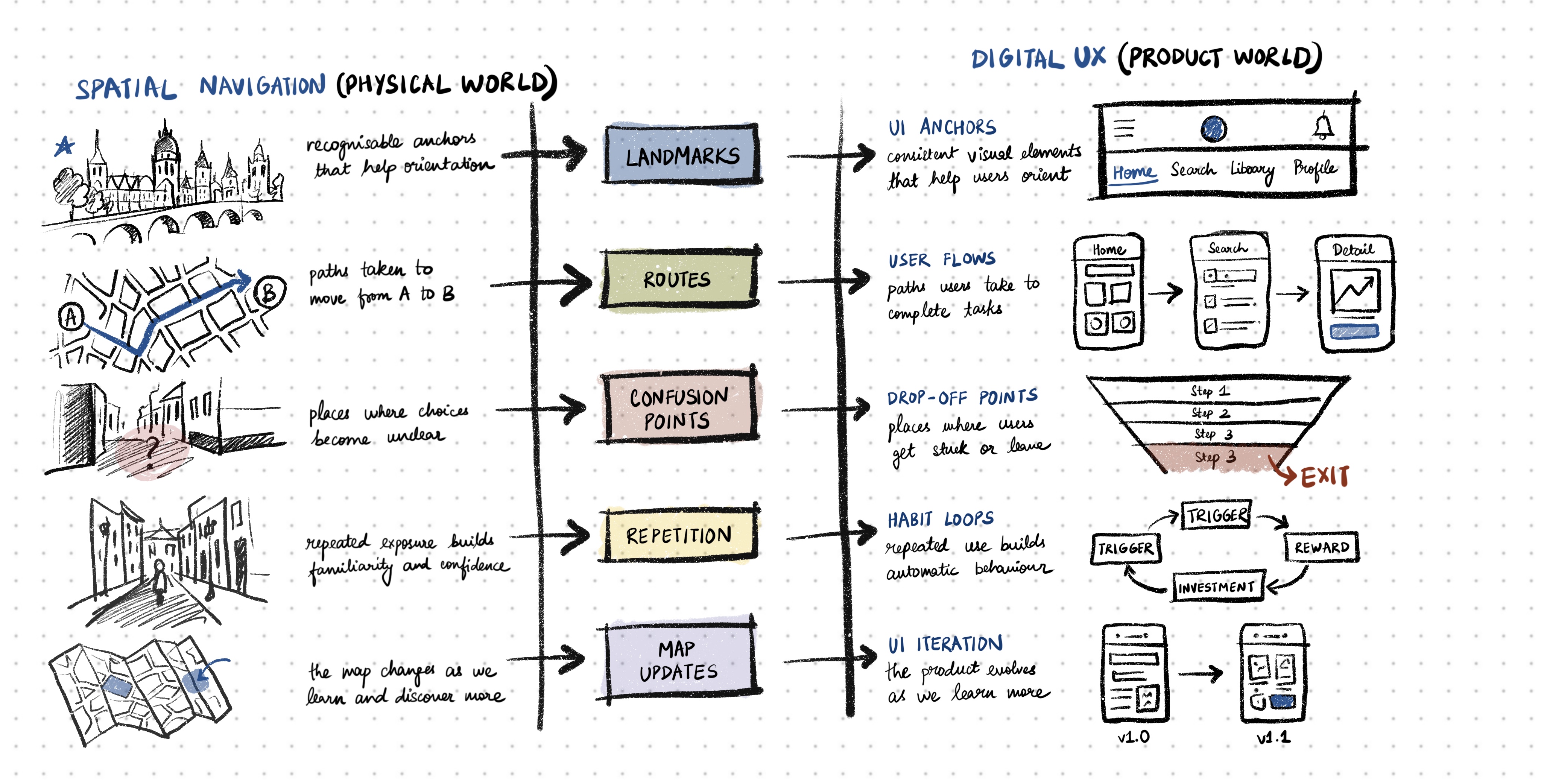
Every product is a space users mentally navigate.
| Spatial Navigation | Digital UX |
|---|---|
| Landmarks | UI anchors |
| Routes | User flows |
| Confusion points | Drop-off points |
| Repetition | Habit loops |
| Map updates | UI iteration |
Key insight
Every product is a space users mentally navigate.
Future spatial UX experiments.
Future exploration directions
- 01Adaptive navigation systems based on user familiarity
- 02Landmark-based UI design systems
- 03Uncertainty-aware route guidance
- 04Memory-enhancing navigation cues
Good systems stabilize understanding.
This experience revealed that navigation is not about getting from point A to point B. It is about maintaining a stable internal model of the world while moving through it.
When that model collapses, users do not get lost physically. They get lost cognitively. Good systems do not just guide movement. They stabilize understanding.

