Pairing Wine
with Cheese
Designing a night for people who Google “what wine goes with Brie.”
One-line thesis
I could have Googled it. But what's the fun in that?
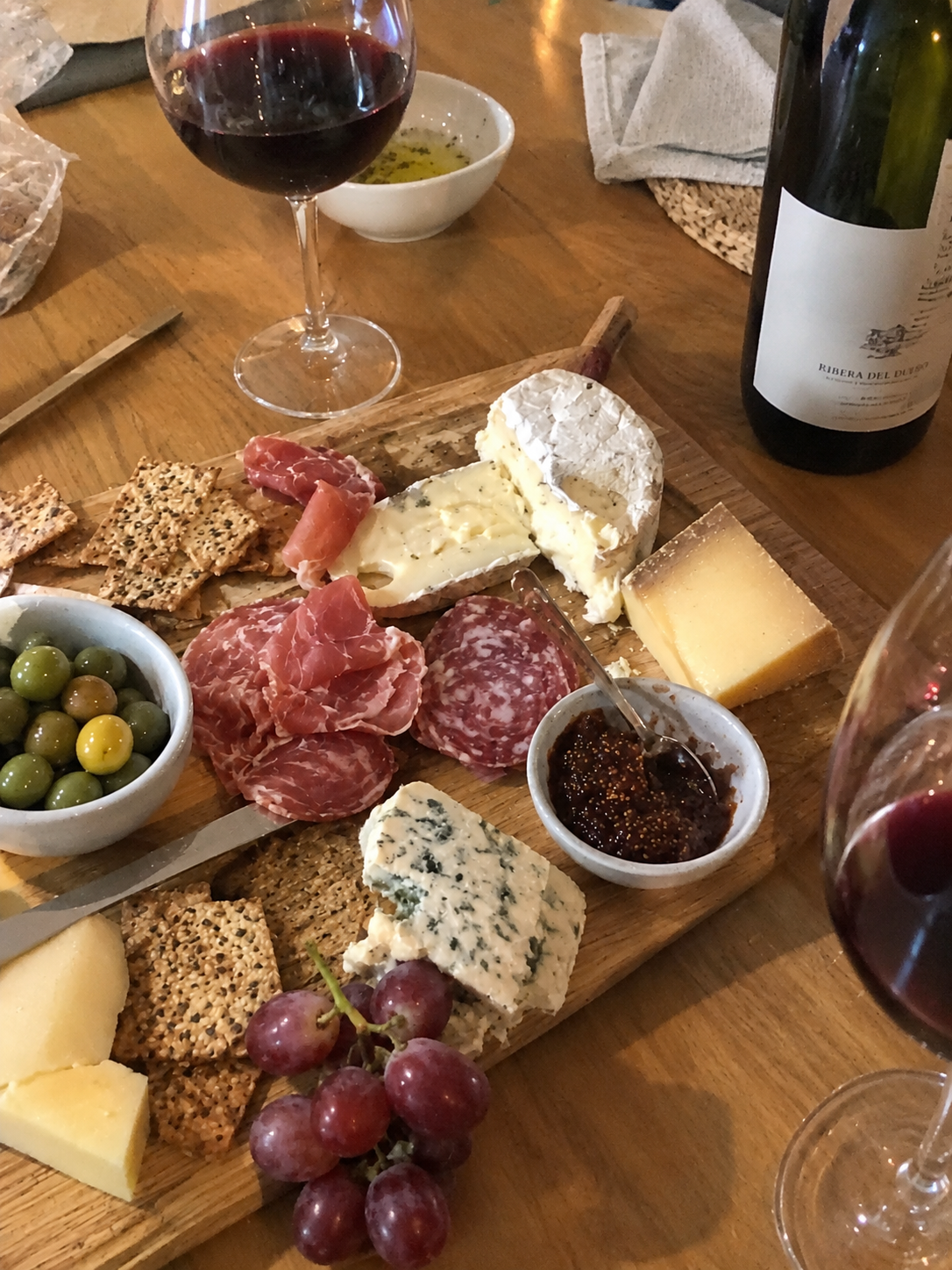

I was hosting a board-game evening and had decided to put together a small cheese board.
The cheese was easy. The wine was easy. Pairing them was weirdly difficult.
I could have Googled “what wine goes with Brie?” and followed the first recommendation. But that felt like outsourcing the fun. Instead, I started looking at the problem as a designer: What actually makes a pairing work? And more importantly: Could I build a system that would let me make the decision myself the next time?
What actually makes a pairing work?
The obvious question was “What wine goes with this cheese?” The question I actually wanted to answer was “What variables should I consider when deciding whether a cheese and a wine will work together?”
The distinction
A conventional recommendation treats pairing as a lookup problem: Cheese → recommended wine. I suspected it was closer to a decision-making problem: Cheese characteristics + wine characteristics + context + preference → pairing.
Personal UX / service-design experiment
Research · Systems thinking · IA · Interaction design · Visualisation
A board-game evening with a mixed cheeseboard and wine selection
A reusable pairing decision system and quick-reference pairing matrix
15 Sep 2025
“There must be a correct pairing.”
This is where the research became interesting. Wine-and-food pairing isn't simply about matching two names from a list. The characteristics of the food can change how the wine is perceived, while the structure of the wine changes how the food feels in combination.
Relevant variables include sweetness, acidity, salt, fat, umami, flavour intensity and spice in food; and sweetness, acidity, tannin, fruitiness, alcohol, complexity and oak in wine.
So: Brie ≠ one flavour. And Chardonnay ≠ one experience.
A young, unoaked Chardonnay and a rich, heavily oaked Chardonnay can behave very differently with the same cheese. Likewise, Brie served with plain crackers is not the same pairing problem as Brie with honey, walnuts and fig jam.
Design implication
The system shouldn't ask ‘Which cheese is this?’ It should ask ‘What are the dominant characteristics of what I'm actually eating?’
I broke the problem into four questions.
The fourth question turned out to be particularly important. Because there isn't necessarily one “correct” pairing. Even formal wine education treats food-and-wine matching as an interaction between multiple characteristics rather than a simple one-to-one lookup. And palate preference matters: people perceive and enjoy flavours differently, so a recommendation cannot fully substitute for personal taste.
The shift
I wasn't building a database of Brie → Chardonnay. I was building a shared vocabulary between two systems.
A pairing isn't just chemistry.
The more I researched the problem, the less useful a purely flavour-based model felt. Food and wine are also cultural systems. People don't approach a cheeseboard as a blank palate. They bring:
They bring
- →Regional traditions
- →Familiarity
- →Memories
- →Social expectations
- →Price perceptions
- →Occasion
- →Learned conventions
- →Personal taste
There is a reason some combinations feel “obvious” to one person and unusual to another. Even wine education recognises occasion, price and individual preferences as part of wine selection, alongside the sensory characteristics.
The distinction
PAIRING LOGIC: ‘These characteristics are likely to work together.’ PERSONAL PREFERENCE: ‘I happen to love this combination.’ Those are not the same thing.
The underlying model can be complex.
The interaction with the model cannot be.
At this point I had a problem. My research model was becoming increasingly sophisticated. Which is good for analysis. But terrible for a user standing in a kitchen holding a piece of cheese.
If someone needs to evaluate nine characteristics for every cheese and another nine for every wine, the system has failed. This became the central design constraint.
I separated the variables into three layers.
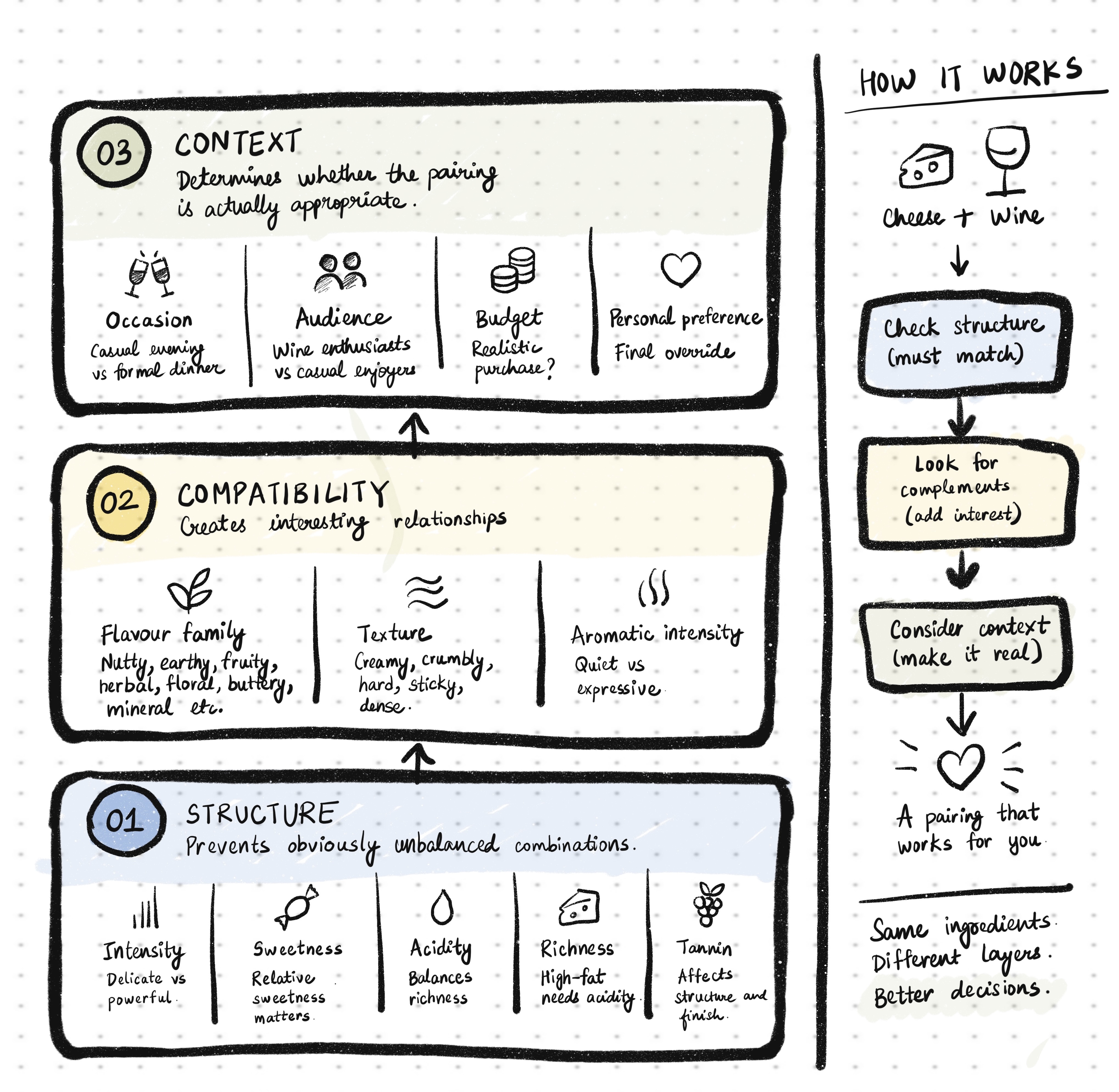
Prevents obviously unbalanced combinations.
Creates interesting relationships.
Determines whether the pairing is actually appropriate.
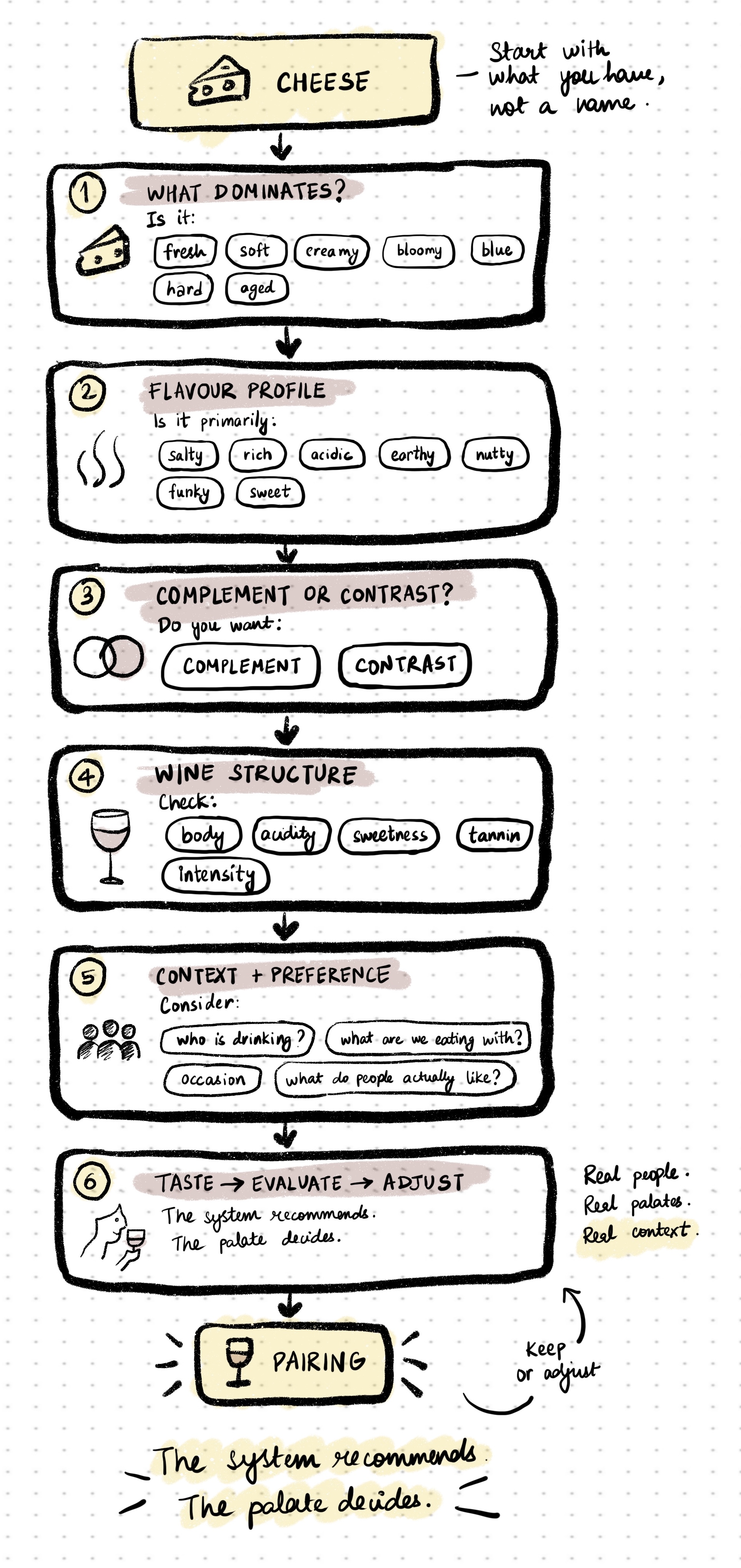
The system became a simple sequence.
The underlying model stayed complex. The interaction collapsed into six steps that anyone could follow while standing in a kitchen.
The headline
The system recommends. The palate decides.
I tested it on real cheeses.
Rather than immediately jumping to a list of “correct answers,” I used the framework to reason through different cheese families. The purpose wasn't to prove that one pairing was objectively superior. It was to see whether the model could produce a defensible choice without relying on a search result.
Soft, creamy, rich, mild to medium intensity, earthy/buttery as maturity increases
DirectionFreshness + acidity, rather than simply Brie = Chardonnay.
Fresh, tangy, acidic, sometimes herbal
DirectionHigh-acid, fresh wines. The pairing logic is stronger than memorising a wine name.
High intensity, salty, pungent, complex
DirectionSweetness as contrast. Demonstrates that matching intensity isn't the only strategy.
Dense, salty, intense, nutty / savoury, greater flavour concentration
DirectionStructured wine with enough intensity. Salt, fat, tannin and acidity interact usefully here.
Turning research into something I could actually use.
Eventually I needed something that could survive outside the case study. Something I could actually keep beside the cheeseboard. So I converted the research into a quick-reference matrix. Not “Google this cheese.” But “Start here, then reason from the profile.”
Important
This is a working framework, not a universal ‘correct pairing chart.’ The sensory logic and examples are starting points, because personal preference and the exact preparation and accompaniments matter.
Then I added the thing a typical pairing chart misses.
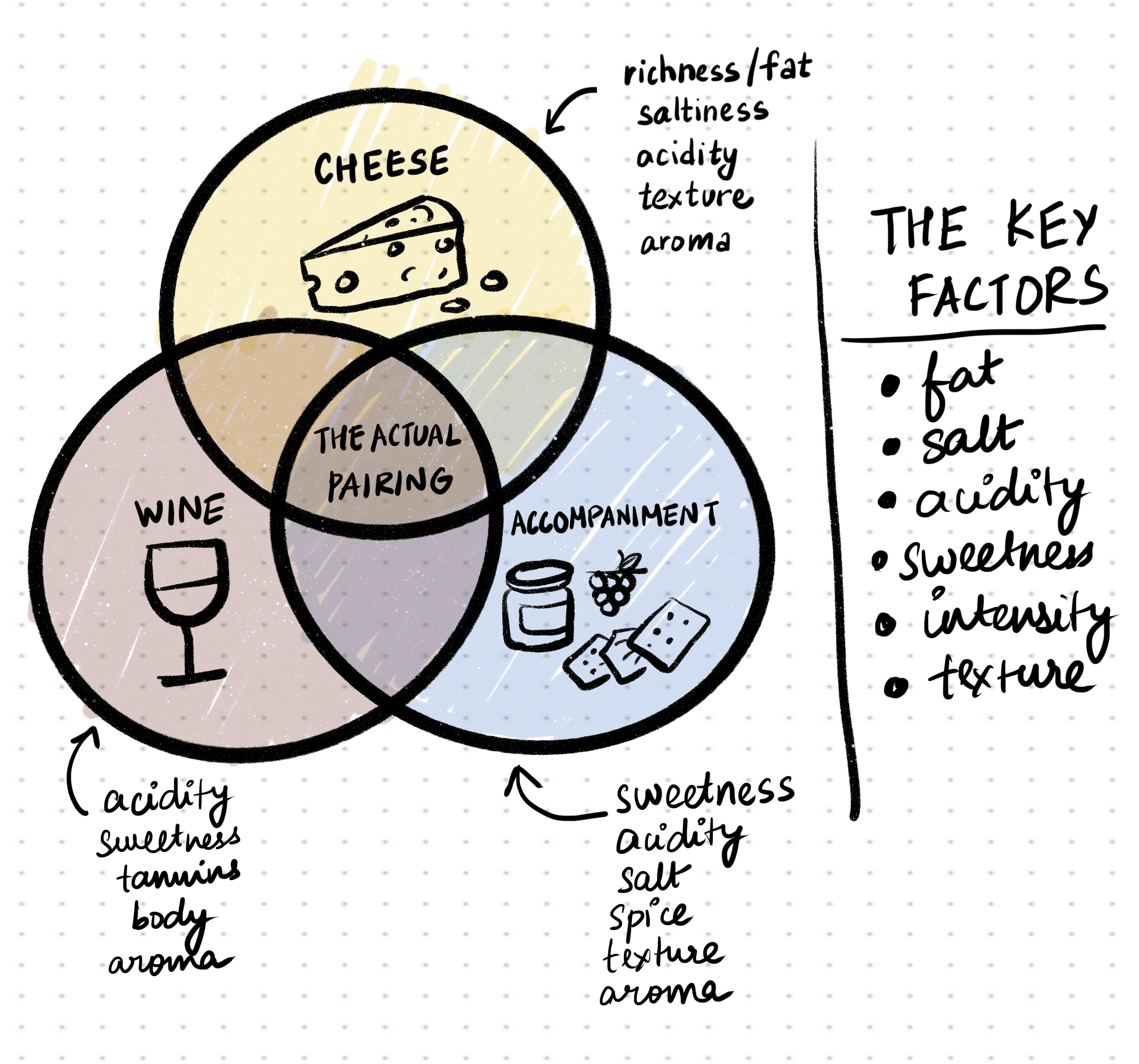
A cheese is rarely eaten alone. So the actual pairing unit became: Cheese + Accompaniment + Wine.
For example: Brie with honey, walnuts and crackers is a different problem from Brie with plain bread. The accompaniment introduces additional variables: sweetness, acidity, salt, spice, texture, aroma. And those can change the balance of the pairing.
Reminder
Designing for the real context of use is more useful than optimising an isolated component.
The most important conceptual finding.
A pairing can be technically defensible and still be unpleasant to someone. So I deliberately avoided designing a scoring system that pretended to produce an objective winner.
The principle
The system provides a starting point. The user provides the final judgement.
This also made the experience more playful. You aren't trying to replace a sommelier. You're giving someone enough structure to become their own slightly overconfident sommelier for the evening.
A two-part tool.
For when I'm standing in front of the fridge.
- →What kind of cheese is this? → identify profile
- →What does it need? → acidity / sweetness / body / intensity
- →Do I want harmony or contrast? → choose strategy
- →What do I already have? → shortlist wine
For future evenings.
The table doesn't give one answer. It gives:
- →Good starting points
- →Why they work
- →What to try next
I deliberately added one more category.
Because if the system only produces conventional answers, it becomes another Google search. For every pairing, I wanted the possibility of a “why not?” pairing. That gave the system a more playful character. And it reflected the original reason I started the project: I wasn't trying to pass a sommelier exam. I was trying to make a board-game evening more interesting.
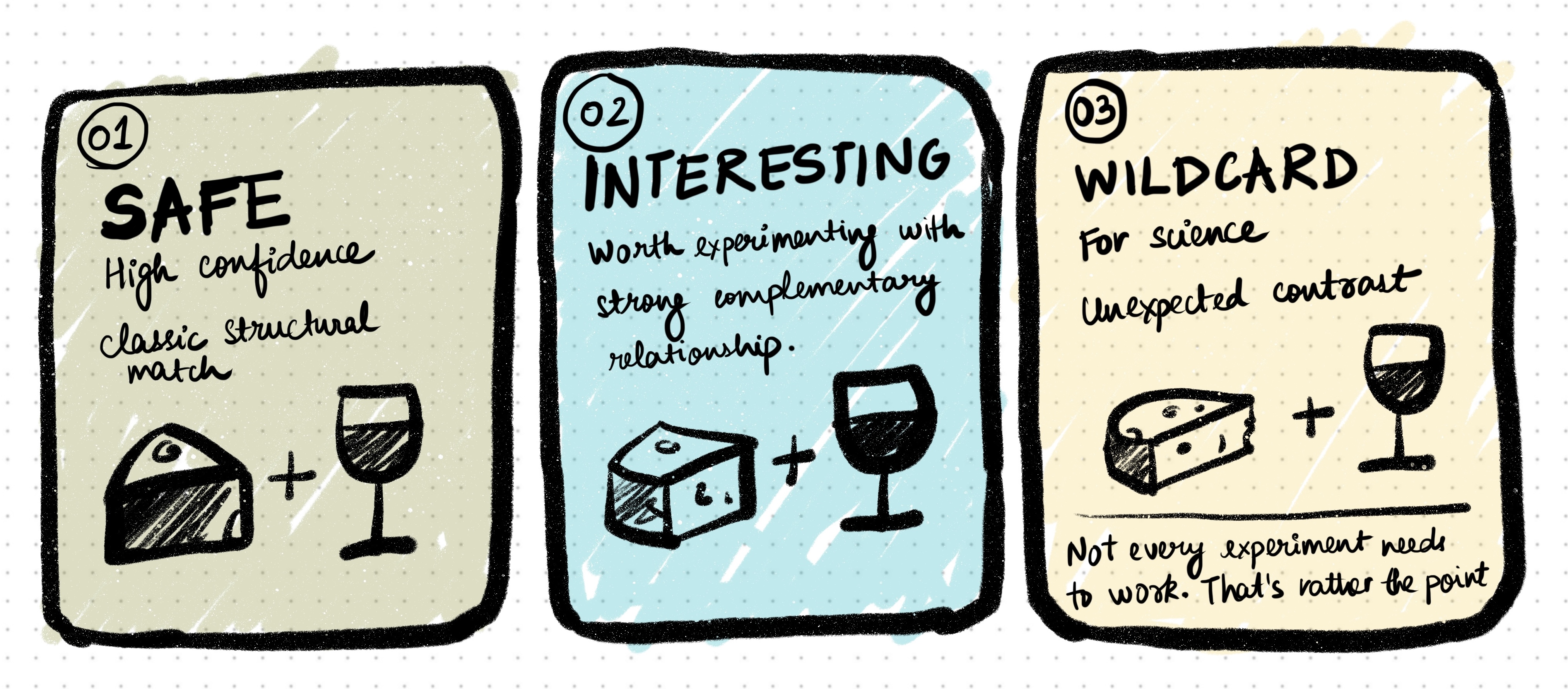
The biggest outcome wasn't a list of pairings.
It was building a decision framework I could reuse.
"What wine goes with this?"
↓ Search
↓ Recommendation
↓ Hope it works
"What is dominant about this cheese?"
↓ Identify the relationship I want
↓ Check wine structure
↓ Account for context
↓ Choose
↓ Taste
↓ Learn
The shift
The system shifted the experience from lookup → reasoning → experimentation.
I started with a recommendation problem
and ended up designing a decision system.
The most interesting part of the project wasn't the final pairing chart. It was deciding what the chart should not try to do.
It shouldn't pretend that taste is objective. It shouldn't hide complexity behind a single recommendation. And it shouldn't make the user understand wine theory before they can use it.
The pattern
Hide complexity → expose useful variables → provide a direction → leave room for judgement. That's a pattern I find useful far beyond wine.

